

Reading the oil-change indicator, what counts as severe duty on the Seacoast, and how summer driving changes the timing.
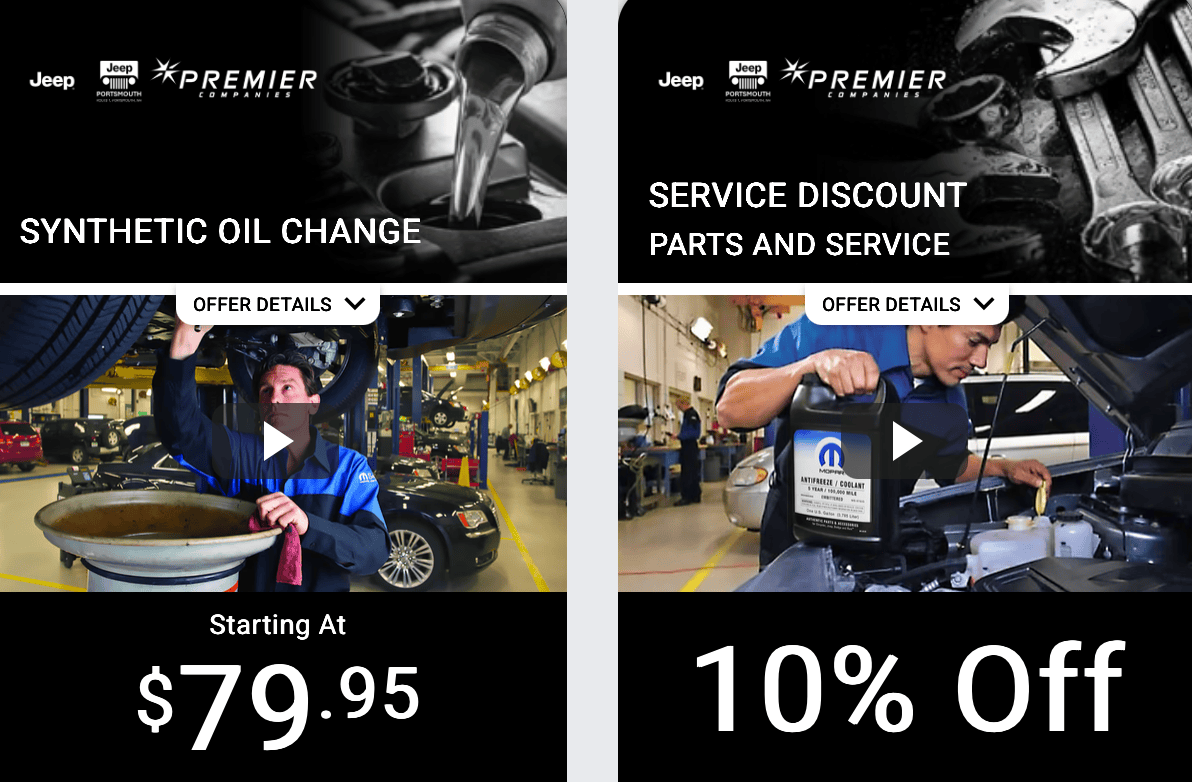
The short answer most owners want first: change your Jeep's oil when the Oil Change Indicator on the dash tells you to, and never let it run past 10,000 miles or 12 months, whichever comes first. When the "Change Oil" message appears, get it done within about 500 miles. The longer answer, the one that actually matters in summer, is that heat, towing to the lakes, beach traffic, and trail dust push most local Jeeps onto the shorter end of that range.
That is the part a generic interval chart misses. We are the Mopar service team at Jeep Portsmouth, 2355 Lafayette Rd, Portsmouth, NH 03801, and we see what heat, dust, and stop-and-go summer driving do to vehicles up and down Route 1. Here is how to read your Jeep's service needs, what counts as harder-than-normal use here, and how to get an oil change done without an appointment. Call (603) 431-8900 with any question on your specific vehicle.
When does your Jeep actually need an oil change?
Modern Jeeps with the 3.6L Pentastar V6 or the 2.0L turbo four do not run on a fixed mileage rule. They use the Oil Change Indicator System, which watches engine temperature, trip length, and how the vehicle is driven, then calls for service when the oil is near the end of its useful life. Follow that message as your primary trigger. Jeep's owner's manual sets a hard ceiling on top of it: under no circumstances should the interval exceed 10,000 miles or 12 months, and for fleet-style use, 350 engine hours, whichever arrives first. Use the full-synthetic oil that meets your engine's Mopar specification, which the indicator's math assumes you are running.
Why Seacoast driving counts as severe duty
Jeep defines a set of "severe" operating conditions that wear oil faster, and under them the indicator can call for service as early as roughly 3,500 miles. A lot of everyday driving here falls squarely into that category, and summer adds several of its own. You are on the severe schedule if your driving regularly includes any of these:
- Trailer towing or carrying heavy loads, like hauling a boat or camper to the lakes on a hot weekend
- Stop-and-go traffic, like beach weekends backing up Route 1
- Off-road use on local trails, where dust and sand get into everything
- Driving on gravel, sand, or unpaved roads, common on trail and back-road routes
- Frequent short trips under about 10 miles, so the engine rarely reaches full operating temperature
- Extended idling or extreme heat, including long waits in summer traffic with the AC working hard
If two or three of those describe your week, do not wait for the absolute 10,000-mile ceiling. Plan on the shorter end, and let the indicator do its job.
Signs it is time, between indicator messages
The dash message is the main trigger, but a few symptoms mean you should come in sooner rather than later: the oil looks dark and gritty on the dipstick, the engine sounds louder or you hear ticking on startup, you notice a burnt-oil smell, or the oil level is low when you check it. Low oil between changes is worth a look on its own, since the turbo four in particular does not tolerate running low. When in doubt, a two-minute level check in our Express Lane beats guessing.
The summer angle: heat, towing, and trail dust
Oil is only half the summer story here. Heat is hard on more than the engine, and a hot tow or a dusty trail day asks a lot of a Jeep all at once. A few habits make a real difference for Seacoast drivers heading to the lakes, the beach, or the woods:
- Before towing a boat or camper in the heat, have the cooling system and transmission fluid checked, since a hot grade with a trailer is exactly when an overheated system shows up
- After trail and beach runs, check the engine air filter and cabin air filter, because sand and dust clog them faster than highway miles do
- Check tire pressure and tread before long summer road trips, since hot pavement and heat both change pressure and worn tread matters most when you are loaded down
- Have the air conditioning checked if it is slow to cool, since summer is when a weak system finally gives up
- Summer is also the right time to deal with last winter's road salt: have the frame, brake lines, and underbody inspected now and addressed before it becomes a brake job
None of that is upsell. It is the difference between a Jeep that shrugs off a hot towing season and one that strands you on the road, and catching underbody corrosion in summer is far cheaper than discovering it next winter.
What to expect, and how to get it done
For a routine oil change, you do not need an appointment. Our Mopar Express Lane handles walk-in oil and filter changes, fluid top-offs, and a multi-point inspection, and you wait while it is done. The inspection is where the summer items get caught early, before a small problem becomes a roadside one. For anything larger, or if you would rather book a time, schedule online and we will have the right Mopar parts and a factory-trained tech ready.
On cost: we do not publish a flat oil-change price here because it depends on your engine and oil capacity, and we would rather quote you the real number than a guess. Check our current service and parts specials for live offers, or ask when you arrive and we will tell you up front.
How to know it is time, and how to schedule
- Watch the indicator. When the "Change Oil" message shows, service within 500 miles. Never exceed 10,000 miles or 12 months.
- Count your conditions. Towing in the heat, beach traffic, trail dust, and short summer trips put you on the severe schedule, so plan for the shorter side.
- Walk in or book. Routine oil change: use the Mopar Express Lane, no appointment. Anything else: schedule online.
Need genuine parts for a project in your own garage? Order from our parts center. Thinking about trading up instead of pouring money into an aging Jeep? Value your trade or contact us with questions.
Frequently asked questions
How often should I change the oil in my Jeep?
Follow the Oil Change Indicator System on your dash, which calculates the interval from how you actually drive. Jeep's owner's manual says the interval should never exceed 10,000 miles or 12 months, whichever comes first. When the "Change Oil" message appears, get it done within about 500 miles.
Does summer driving change how often I need service?
Yes. Towing a boat or camper in the heat, stop-and-go beach traffic, off-road trail use, frequent short trips, and long idles in hot traffic are all severe operating conditions, which can make the indicator call for an oil change as early as about 3,500 miles. Many local drivers are on the severe schedule without realizing it.
Do I need an appointment for an oil change?
No. The Mopar Express Lane handles walk-in oil and filter changes with a multi-point inspection while you wait. For larger service you can schedule a time online.
How much does an oil change cost?
It depends on your engine and oil capacity, so we quote the exact price rather than publish a flat rate. Check our current service and parts specials for live offers, or ask when you arrive and we will tell you up front.
What summer service should I do before towing or a road trip?
Before towing a boat or camper or heading out on a long drive, have the cooling system, transmission fluid, tires, and air conditioning checked, and replace clogged engine and cabin air filters after dusty trail or beach runs. A summer multi-point inspection in the Express Lane catches most of it in one visit.