Reference
2026 Jeep Grand Wagoneer Specs NH
Every published dimension, weight, capacity and rating for both wheelbases, with the configuration each figure belongs to.
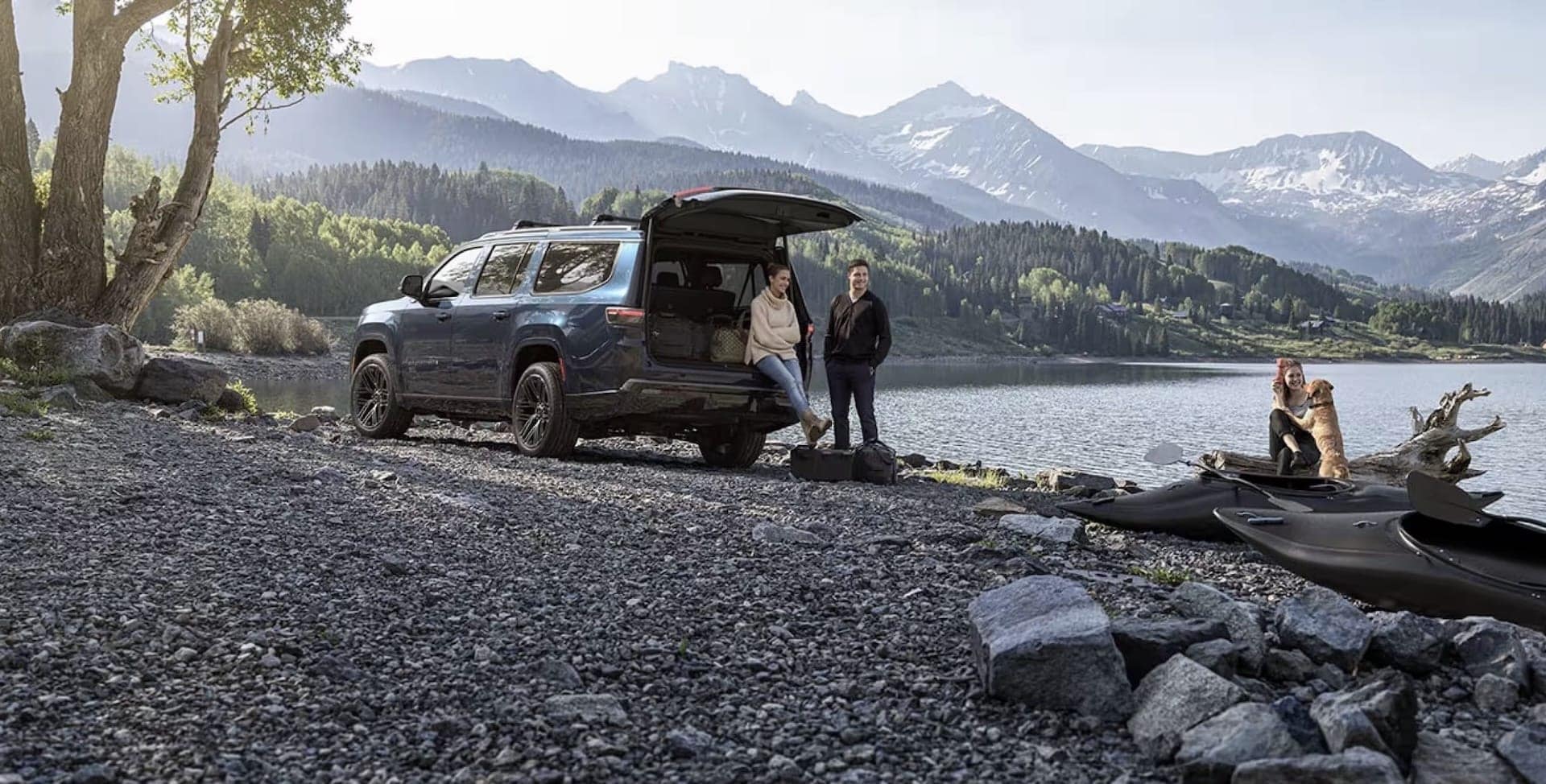
This page carries the published specifications for the 2026 Jeep Grand Wagoneer and Grand Wagoneer L, organised by what a buyer in NH actually measures against: NH garage bays, older driveways, trailer tongues and the space behind the third row. Every figure names the configuration it belongs to, because on this vehicle several of the headline numbers change with wheelbase, drivetrain or suspension. That matters in NH, where four-wheel drive is the default order. For the trim walk see all trims compared; for the model overview see the Grand Wagoneer overview.
Powertrain
Engine Specifications
| Engine | 3.0L Hurricane Twin Turbo, Standard Output |
| Configuration | Inline six-cylinder, twin turbocharged, direct injection |
| Displacement | 183 cubic inches, 2,993 cc |
| Bore and stroke | 3.31 in x 3.54 in |
| Compression ratio | 10.4:1 |
| Horsepower | 420 at 5,200 rpm |
| Torque | 468 lb-ft at 3,500 rpm |
| Transmission | TorqueFlite eight-speed automatic, 8.6 overall ratio spread |
| Fuel | 89 octane recommended, 87 octane acceptable |
This engine is standard on every configuration, both wheelbases. Deeper coverage of the driveline is on the engine and performance page.
Outside
Exterior Dimensions
| Measurement | Grand Wagoneer | Grand Wagoneer L |
|---|
| Wheelbase | 123.0 in | 130.0 in |
| Overall length | 216.1 in | 228.1 in |
| Width at mirrors | 94.0 in, both bodies |
| Body width, mirrors excluded | 83.6 in, both bodies |
| Height at roof rail | 79.8 in | 79.7 in |
| Height at antenna | 77.3 in, both bodies |
| Turning diameter, curb to curb | 40.2 ft | 42.2 ft |
| Fuel tank | 26.5 gal | 30.5 gal |
| Drag coefficient | 0.364 |
Ground clearance and approach angles depend on the suspension, and quoting a single figure for this vehicle is wrong. On the standard coil-spring suspension ground clearance is 7.4 inches; with Quadra-Lift air suspension in its Off Road 2 setting it is 10.1 inches. Both figures are measured on the 275/55R20 tire.
| Measurement | Standard suspension | Air suspension, Off Road 2 |
|---|
| Ground clearance | 7.4 in | 10.1 in |
| Approach angle | 21.4 degrees | 25.2 degrees |
| Breakover angle | 18.6 degrees | 22.0 degrees |
| Departure angle | 21.2 degrees | 24.0 degrees |
Curb weight is published per configuration, in pounds:
| Configuration | Curb weight | GVWR | Weight distribution, front/rear |
|---|
| Grand Wagoneer, rear-wheel drive | 5,730 pounds | 7,300 pounds | 50/50 |
| Grand Wagoneer, four-wheel drive | 5,940 pounds | 7,500 pounds | 52/48 |
| Limited, four-wheel drive | 6,004 pounds | 7,600 pounds | 51/49 |
| Summit, four-wheel drive | 6,175 pounds | 7,800 pounds | 52/48 |
| Grand Wagoneer L, rear-wheel drive | 5,980 pounds | 7,400 pounds | 51/49 |
| Grand Wagoneer L, four-wheel drive | 6,185 pounds | 7,700 pounds | 52/48 |
| Limited L, four-wheel drive | 6,285 pounds | 7,700 pounds | 52/48 |
| Summit L, four-wheel drive | 6,444 pounds | 7,950 pounds | 52/48 |
Inside
Interior Dimensions
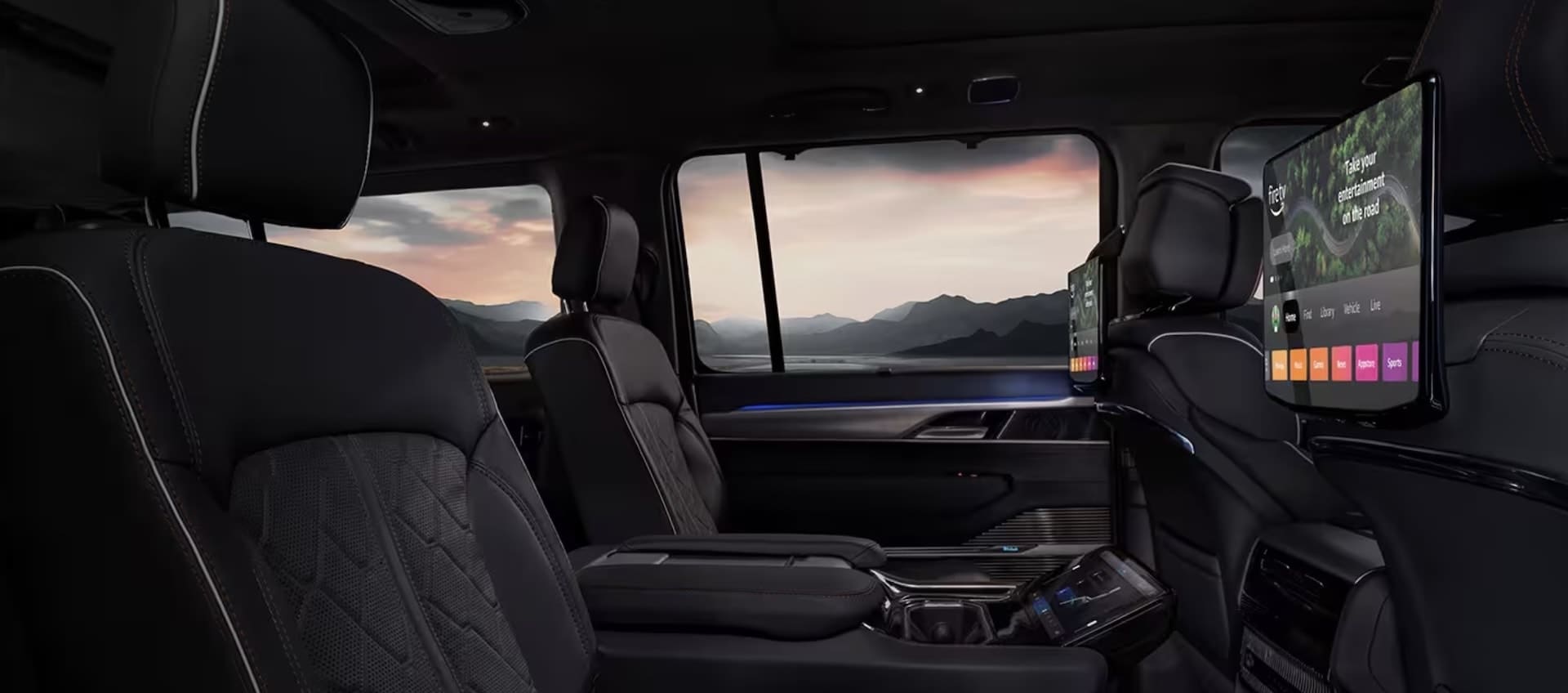
Interior dimensions are identical in both wheelbases. The extra seven inches of wheelbase on the Grand Wagoneer L go entirely to cargo behind the third row, not to occupants. Headroom figures are given with and without the panoramic sunroof, which costs measurable height at every row.
| Measurement | First row | Second row | Third row |
|---|
| Headroom | 41.3 in / 39.3 with sunroof | 40.0 in / 38.4 with sunroof | 39.0 in / 38.5 with sunroof |
| Legroom | 40.9 in | 42.7 in | 36.6 in |
| Shoulder room | 66.1 in | 65.2 in | 64.4 in |
| Hip room | 63.5 in | 63.0 in | 51.6 in |
| Knee clearance | Not published | 6.7 in | 1.9 in |
Total interior passenger volume is 182.4 cubic feet. Combined passenger and cargo volume is 210.3 cubic feet in the Grand Wagoneer and 225.1 in the Grand Wagoneer L. The cargo and third row page carries the seat-configuration deep dive; the summary table is below.
Capacity
Capacity and Capability
| Configuration | Axle | Max trailer weight |
|---|
| Grand Wagoneer, rear-wheel drive | 3.55 | 6,210 lbs |
| Grand Wagoneer, four-wheel drive | 3.55 | 6,030 lbs |
| Grand Wagoneer, four-wheel drive | 3.92 | 10,000 lbs |
| Grand Wagoneer L, rear-wheel drive | 3.55 | 5,960 lbs |
| Grand Wagoneer L, four-wheel drive | 3.55 | 5,770 lbs |
| Grand Wagoneer L, four-wheel drive | 3.92 | 9,860 lbs |
All trailer ratings are properly equipped on a conventional hitch. Payload varies by configuration, roughly 1,420 to 1,570 pounds. On every wheelbase, drivetrain and trim, stated once because it does not vary. On the 3.92 axle, gross combined weight rating is 15,000 pounds, or 16,500 pounds in the properly equipped four-wheel-drive Max Tow configuration, with a maximum tongue weight of 820 pounds and 981 pounds respectively on the short wheelbase, and 793 and 945 pounds on the Grand Wagoneer L. Cargo volume behind the third row is 27.9 cubic feet in the Grand Wagoneer and 42.6 in the Grand Wagoneer L; behind the second row the Grand Wagoneer holds 70.8 cubic feet, and with every rear seat folded it opens to 116.7.
Rolling Stock
Wheels, Tires, and Brakes
| Configuration | Wheels | Tires |
|---|
| Grand Wagoneer | 18 x 8 standard, 20 x 9 available | 275/65R18 Bridgestone Dueler H/T |
| Limited, short wheelbase | 20 x 9 standard, 22 x 9 available | 275/55R20 Nexen Roadian HTX RH5 |
| Limited, long wheelbase | 20 x 9 standard | 275/55R20 Bridgestone Dueler H/L Alenza |
| Upland | 20 x 9 Luster Grey Metallic | 275/55R20 Falken Wildpeak all-terrain |
| Summit and Limited Reserve | 22 x 9 standard | 285/45R22XL Pirelli Scorpion Verde |
Front and rear track measure 68.5 and 68.3 inches. The front differential is an open unit with an 8.5-inch ring gear; the rear is a limited-slip with a 10.2-inch ring gear, with an electronic limited-slip differential available as part of the heavy-duty trailer tow package.
Efficiency
Fuel Economy and Range
| Configuration | City | Highway | Combined |
|---|
| Grand Wagoneer, rear-wheel drive | 17 | 24 | 19 |
| Grand Wagoneer, four-wheel drive | 17 | 23 | 19 |
| Grand Wagoneer L, rear-wheel drive | 17 | 24 | 19 |
| Grand Wagoneer L, four-wheel drive | 16 | 22 | 18 |
Ratings are from fueleconomy.gov, and all four configurations certify on regular gasoline. Paired with the 26.5-gallon tank on the short wheelbase and 30.5 gallons on the L, the highway ratings put both bodies well past 500 miles of theoretical range.
Equipment
Key Features by Trim
Legend: S = standard, O = available, – = not standard equipment on that configuration.
| Feature | Grand Wagoneer | Limited | Summit |
|---|
| Uconnect 5C NAV, 12-inch touchscreen | S | S | S |
| 12.3-inch driver display | – | O | S |
| Heated and ventilated front seats | S | S | S |
| Heated second-row seats | – | S | S |
| Second-row captain's chairs | S | S | S |
| Tri-pane panoramic sunroof | – | O | S |
| 19-speaker McIntosh MX950 audio | – | O | S |
| Head-up display | – | O | S |
| Quadra-Lift air suspension | O | O | S |
| Front passenger interactive display | – | – | O |
| Rear seat entertainment, dual 10.1-inch | – | O | O |
| Hands-free power liftgate | S | S | S |
This is the short decision grid. The full per-configuration walk, including the Upland, Altitude, Reserve and Obsidian packages, is on the trims compared page.
Safety
Safety and Compliance
Active Driving Assist is standard on every configuration. Jeep describes it in its own words as a hands-on-wheel, eyes-on-road system that identifies appropriate roads, centers the vehicle in its lane and manages speed and braking. It is not a hands-free system.
Standard driver assistance includes Adaptive Cruise Control with Stop and Go, Blind Spot Monitoring with Rear Cross Path Detection, Full-Speed Forward Collision Warning with Active Braking, Pedestrian and Cyclist Emergency Braking and the Active Lane Management System. Available systems include Intersection Collision Assist, Traffic Sign Recognition, Drowsy Driver Detection, ParkSense Automated Park Assist and the 360-degree Surround View Camera. Jeep's own tally across the vehicle runs to more than 170 safety and security features, standard and available combined.
Both rating bodies have published results for this vehicle, including one adverse result, and the technology and safety page carries them in full.
Coverage
Warranty Coverage
| Coverage | Term |
|---|
| Basic limited warranty | 3 years or 36,000 miles |
| Specified components | 1 year or 12,000 miles |
| Powertrain limited warranty | 5 years or 60,000 miles |
| Corrosion, all panels | 3 years, unlimited mileage |
| Outer panel rust-through | 5 years, unlimited mileage |
| Roadside assistance | 5 years or 60,000 miles |
Rust-through coverage is worth reading twice on the NH coast, where salt reaches the underbody from the road and the air both. The specified-components term covers wear items including brake rotors, pads, linings and drums, bulbs, clutch discs and key fobs. Intervals and ownership costs are on the maintenance schedule page.
Translation
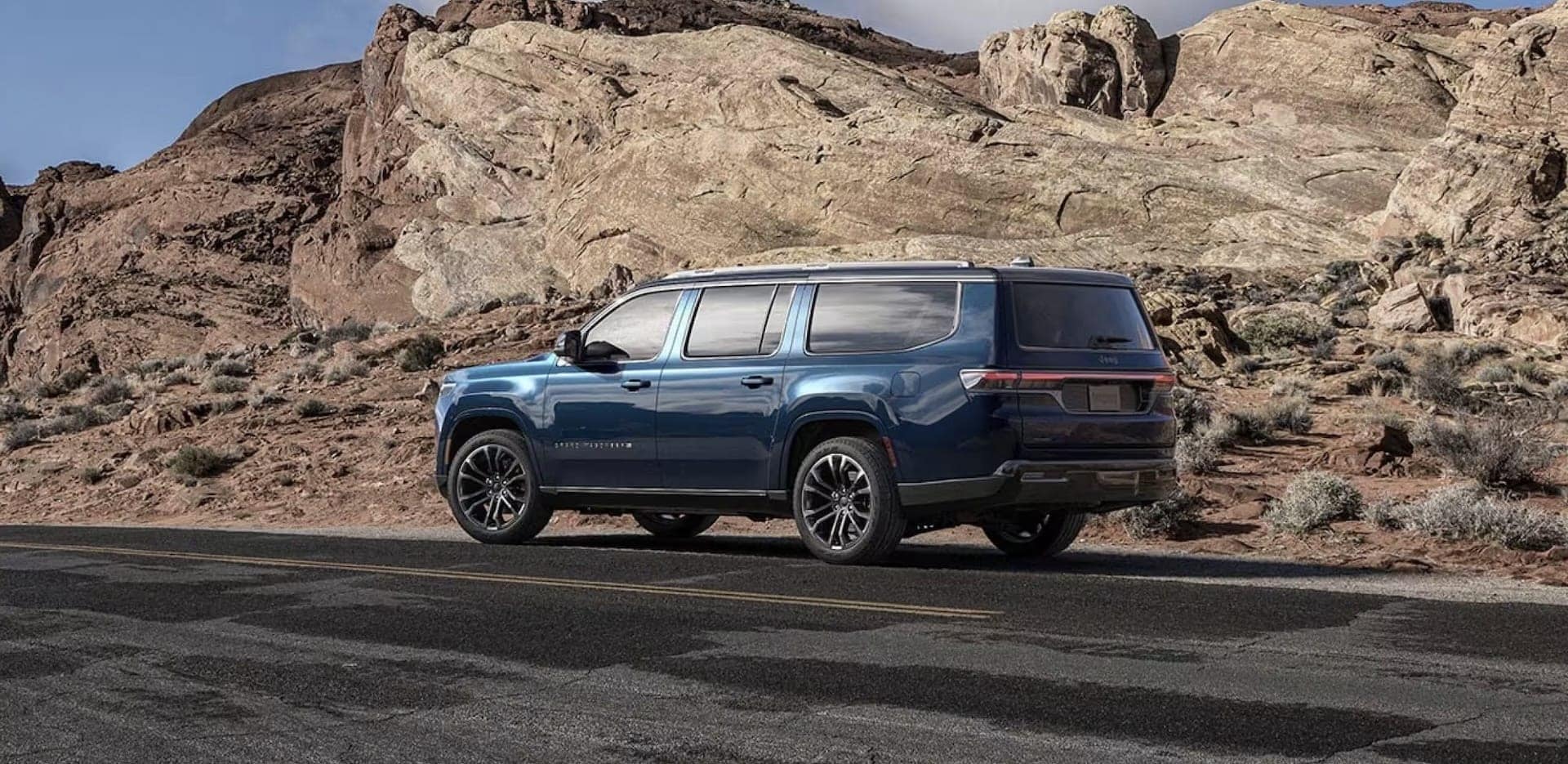
What These 2026 Grand Wagoneer Numbers Mean in Practice
| The number | What it means where you park |
|---|
| 94.0 in wide at the mirrors | A single garage bay is typically eight to nine feet of opening. This fits, but on a narrow bay the margin per side is measured in inches. Fold the mirrors and you are working with the 83.6-inch body width instead. |
| 216.1 in long, or 228.1 for the L | Against a standard twenty-foot garage bay the short wheelbase leaves roughly two feet; the Grand Wagoneer L leaves roughly one. Measure before you commit to the longer body. |
| 40.2 ft turning circle, 42.2 for the L | Two feet of difference is a three-point turn on a narrow street becoming a five-point turn. It shows up on older NH downtown blocks more than anywhere else. |
| 7.4 in clearance, or 10.1 with air suspension | The standard figure clears an NH plowed berm and a rutted dirt road. The air-suspension figure at Off Road 2 is what clears an unmaintained track. Quoting the higher number on a coil-sprung car is the common mistake. |
| 36.6 in third-row legroom | Enough for an adult on a two-hour drive rather than a token bench. It is identical in both bodies, so the L buys you cargo, not passenger room. |
| About 1,560 lb payload | Seven adults and their luggage reach that limit faster than most buyers expect, and trailer tongue weight counts against it too. If you routinely load all three rows and tow, weigh the combination rather than assuming. |
Questions
Specifications FAQs
How long is the 2026 Jeep Grand Wagoneer?
The Grand Wagoneer is 216.1 inches long on a 123.0-inch wheelbase. The long-wheelbase Grand Wagoneer L is 228.1 inches on a 130.0-inch wheelbase, twelve inches longer overall.
Will a Grand Wagoneer fit in a standard garage?
Usually, but check first. It is 94.0 inches wide at the mirrors and 83.6 inches across the body, against a typical single bay opening of eight to nine feet. Height is 79.8 inches at the roof rail. Length is the tighter constraint on the Grand Wagoneer L at 228.1 inches, which leaves about a foot in a standard twenty-foot bay.
How much does a 2026 Grand Wagoneer weigh?
Between 5,730 and 6,444 pounds depending on configuration. The lightest is the rear-wheel-drive short-wheelbase Grand Wagoneer at 5,730 pounds; the heaviest is the four-wheel-drive Summit L at 6,444. Gross vehicle weight rating runs from 7,300 to 7,950 pounds across the same range.
What is the ground clearance of the 2026 Grand Wagoneer?
It depends on the suspension. On the standard coil-spring setup it is 7.4 inches. With Quadra-Lift air suspension in its Off Road 2 setting it is 10.1 inches. Both are measured on the 275/55R20 tire. A single unqualified figure for this vehicle is not accurate.
What is the payload capacity of the 2026 Grand Wagoneer?
It varies by configuration, from about 1,420 pounds on the long-wheelbase L to about 1,570 on the rear-wheel-drive short wheelbase, with the four-wheel-drive short wheelbase near 1,560. Payload counts driver, passengers, cargo, options and trailer tongue weight together, so a full third row of adults uses most of it.
Is the Grand Wagoneer L roomier inside for passengers?
Not for passengers. Headroom, legroom, shoulder room and hip room are identical in both bodies at every row, including 36.6 inches of third-row legroom. Those extra seven inches of wheelbase are spent behind row three, lifting that space from 27.9 to 42.6 cubic feet.
Measure It Against Your Own Garage
Numbers on a page only go so far. Come put a tape measure on one at our NH showroom, or let us pull the specs on a unit we have in stock.
Keep Researching