Head to Head
2026 Jeep Grand Wagoneer vs Ford Expedition
The Jeep tows more and carries more behind the third row. The Ford drives itself on the highway. Here is the honest split.
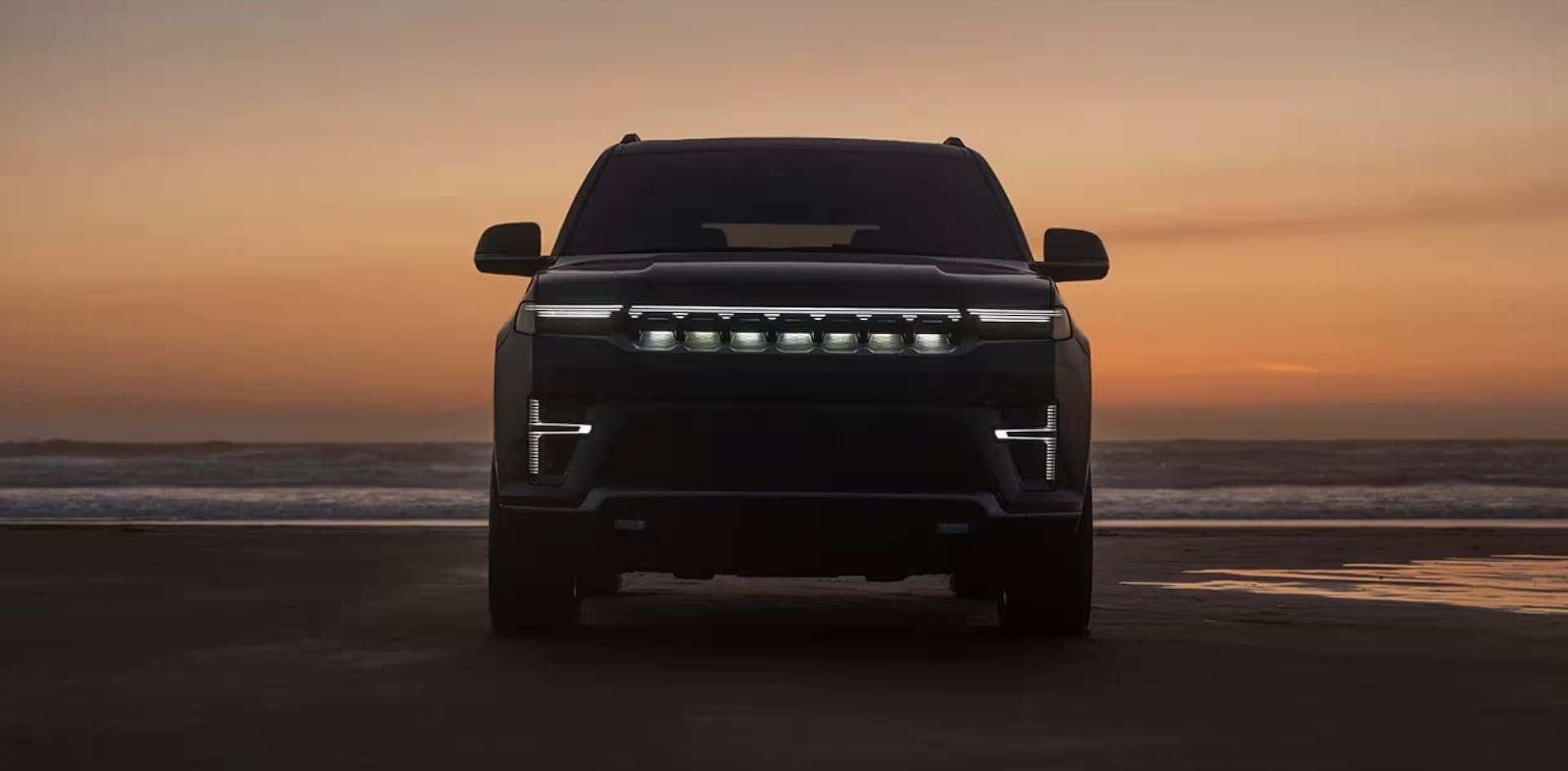
These two are the natural cross-shop for a NH family that needs three genuine rows and a real tow rating. The 2026 Grand Wagoneer opens at $63,995 with a 420-horsepower Hurricane twin-turbo six and a 10,000-pound maximum tow rating; the 2026 Expedition opens at $62,700 with a 400-horsepower twin-turbo EcoBoost V6 and a 9,600-pound maximum. For NH buyers, where they genuinely separate is behind the third row, where the Grand Wagoneer holds 27.9 cubic feet against the Expedition's 21.6, both measured the same way on the standard wheelbase.
Jeep Portsmouth is the Jeep-only store on the NH Seacoast and sells one of these two, so read the wins section for the competitor as carefully as the one for ours. The Expedition has a real advantage we cannot match, and it is on this page in plain language.
Quick Take: Grand Wagoneer or Expedition?
For most three-row buyers the Grand Wagoneer is the stronger pick. It tows 400 pounds more at matched configuration, carries 6.3 more cubic feet behind the third row and 10 more behind the second, returns better EPA figures in every comparable drivetrain, and offers a front passenger touchscreen the Expedition does not list at any trim.
Choose the Expedition if hands-free highway driving matters to you. Ford's BlueCruise lets you take your hands off the wheel on mapped highways; Jeep's Active Driving Assist is a hands-on system and no Grand Wagoneer offers a hands-free equivalent. The Expedition also has the more powerful engine option and costs about $1,495 less to get into once destination is counted on both sides.
The Jeep
2026 Grand Wagoneer Overview
For 2026 the Grand Wagoneer absorbed the standard Wagoneer and dropped its entry price by more than twenty thousand dollars, so the vehicle that once started near six figures now opens at $63,995 before the $2,795 destination charge. One engine serves the entire lineup: a 3.0-liter Hurricane twin-turbocharged inline-six making 420 horsepower and 468 lb-ft. Seven configurations run from that base car to a $100,310 Summit Reserve, and every one of them shares the engine, the seven-seat cabin and the 12-inch touchscreen.
Its case rests on space and capability. Third-row legroom is 36.6 inches, cargo behind that row is 27.9 cubic feet, and a properly equipped four-wheel-drive build tows 10,000 pounds. Spend $3,000 on the long-wheelbase Grand Wagoneer L and the space behind row three becomes 42.6 cubic feet.
The Ford
2026 Ford Expedition Overview
The Expedition is a thoroughly modern full-size SUV and a strong vehicle. Ford offers four models, Active, Platinum, Tremor and King Ranch, in standard or MAX long-wheelbase form, seven configurations in total, opening at $62,700 before a $2,595 destination charge. The Tremor is short-wheelbase only.
Power comes from a 3.5-liter twin-turbocharged EcoBoost V6 making 400 horsepower and 480 lb-ft, with a High-Output version at 440 horsepower and 510 lb-ft standard on the Tremor and available on the Platinum. A ten-speed automatic handles all of it. Rear-wheel drive is standard on the Active and four-wheel drive is standard from the Platinum up. Ford's interior headline is a 24-inch panoramic display paired with a 13.2-inch centre screen, running the Ford Digital Experience with Google built in.
Powertrain
Powertrain Comparison
| Measure | 2026 Grand Wagoneer | 2026 Ford Expedition |
|---|
| Engine | 3.0L Hurricane twin-turbo inline-six | 3.5L twin-turbo EcoBoost V6 |
| Horsepower, standard engine | 420 | 400 |
| Torque, standard engine | 468 lb-ft | 480 lb-ft |
| Upgrade engine | None offered | High-Output, 440 hp / 510 lb-ft |
| Transmission | 8-speed automatic | 10-speed automatic |
| Max towing | 10,000 lbs, short wheelbase 4x4 with the 3.92 axle from the heavy-duty tow package | 9,600 lbs, short wheelbase 4x4 with the 3.73 axle and the Heavy-Duty Trailer Tow Package |
| Max towing, long wheelbase | 9,860 lbs | 9,000 lbs |
| EPA, rear-wheel drive | 17 / 24 / 19 | 16 / 24 / 19 |
| EPA, four-wheel drive | 17 / 23 / 19 | 15 / 22 / 18 |
| Fuel requirement | 89 recommended, 87 acceptable | 87 on the standard engine, 91 or higher on the High-Output |
Both maximum tow ratings are properly equipped on a conventional hitch and both require four-wheel drive, a specific axle ratio and the manufacturer's heavy-duty tow package, so this is a like-for-like comparison. The Grand Wagoneer's 10,000 pounds is 400 more than the Expedition's 9,600, and the gap widens on the long wheelbase, where the Grand Wagoneer L holds 9,860 against the Expedition MAX's 9,000.
Ford states its horsepower and torque figures on premium fuel to the SAE J1349 standard, and notes that horsepower and torque are independent attributes that may not be achieved simultaneously. That applies to the 400-horsepower standard engine as well as the High-Output. Jeep's 420 and 468 are SAE J2723 figures on an engine that accepts regular 87 octane. Worth knowing when the two spec sheets sit side by side.
Cabin
Interior and Technology Comparison
| Measure | 2026 Grand Wagoneer | 2026 Ford Expedition |
|---|
| Cargo behind third row | 27.9 cu ft | 21.6 cu ft |
| Cargo behind second row | 70.8 cu ft | 60.8 cu ft |
| Maximum cargo, both rear rows folded | 116.7 cu ft | Ford's published figure is internally inconsistent |
| Cargo behind third row, long wheelbase | 42.6 cu ft | 36.1 cu ft |
| Third-row legroom | 36.6 in | 36.5 in |
| Second-row legroom | 42.7 in | 41.1 in |
| Centre touchscreen | 12 in | 13.2 in |
| Driver display | 10.25 in, or 12.3 in | 24-inch panoramic display |
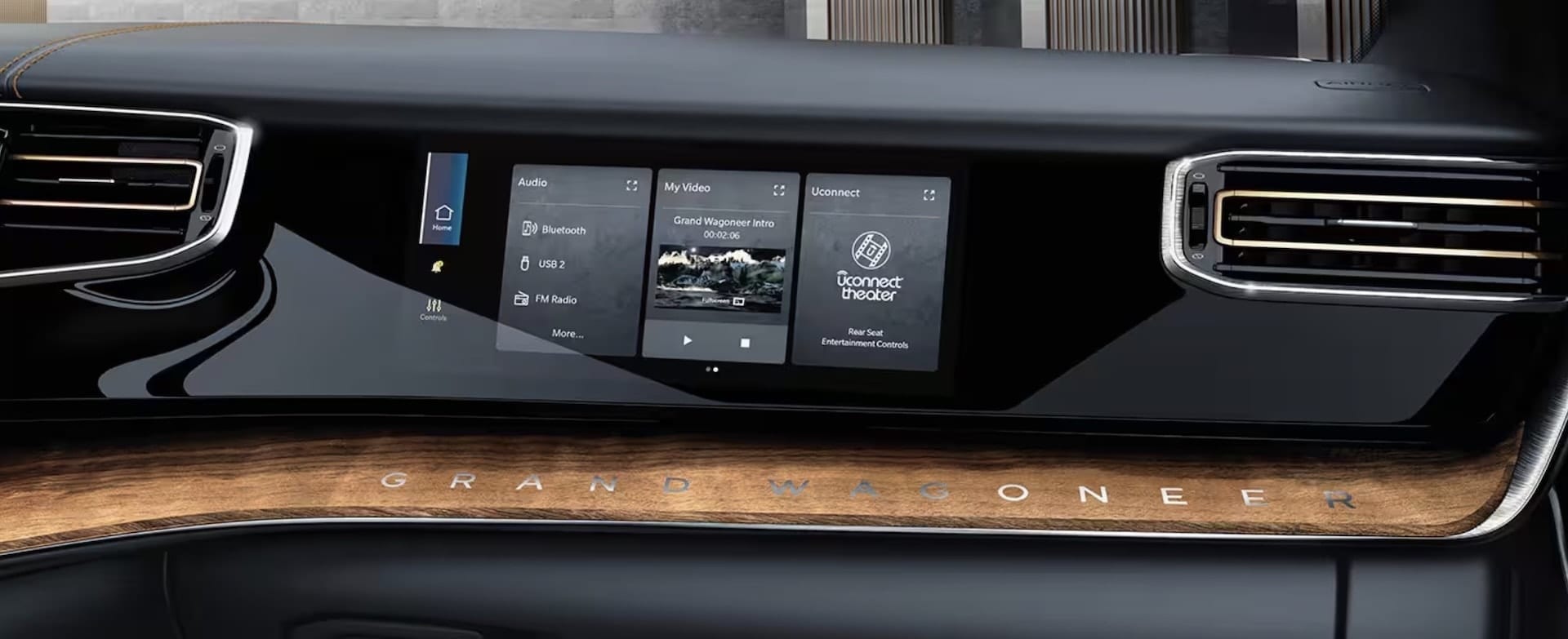
| Front passenger screen | 10.25-inch interactive display, available | Ford does not list one |
| Hands-free highway driving | Not offered | BlueCruise |
| Premium audio | McIntosh, up to 23 speakers | Bang and Olufsen |
One cell above carries no Ford number on purpose. Ford's published maximum-cargo figure lists the short-wheelbase Expedition at a larger volume than the longer MAX, which cannot be right, so we have left it out rather than repeat a figure we cannot reconcile. The Grand Wagoneer's maximum with both rear rows folded is 116.7 cubic feet. The rest of the cargo figures above compare Ford's standard measurement against Jeep's, which matters because Ford publishes a second, larger set taken with the seats slid to their most favourable positions. Ford's marketing tends to quote 22.9 cubic feet behind the third row rather than 21.6, and 69.9 behind the second rather than 60.8. Those are legitimate Ford figures but they are not measured the same way as Jeep's, so this page uses the standard measurement on both sides.
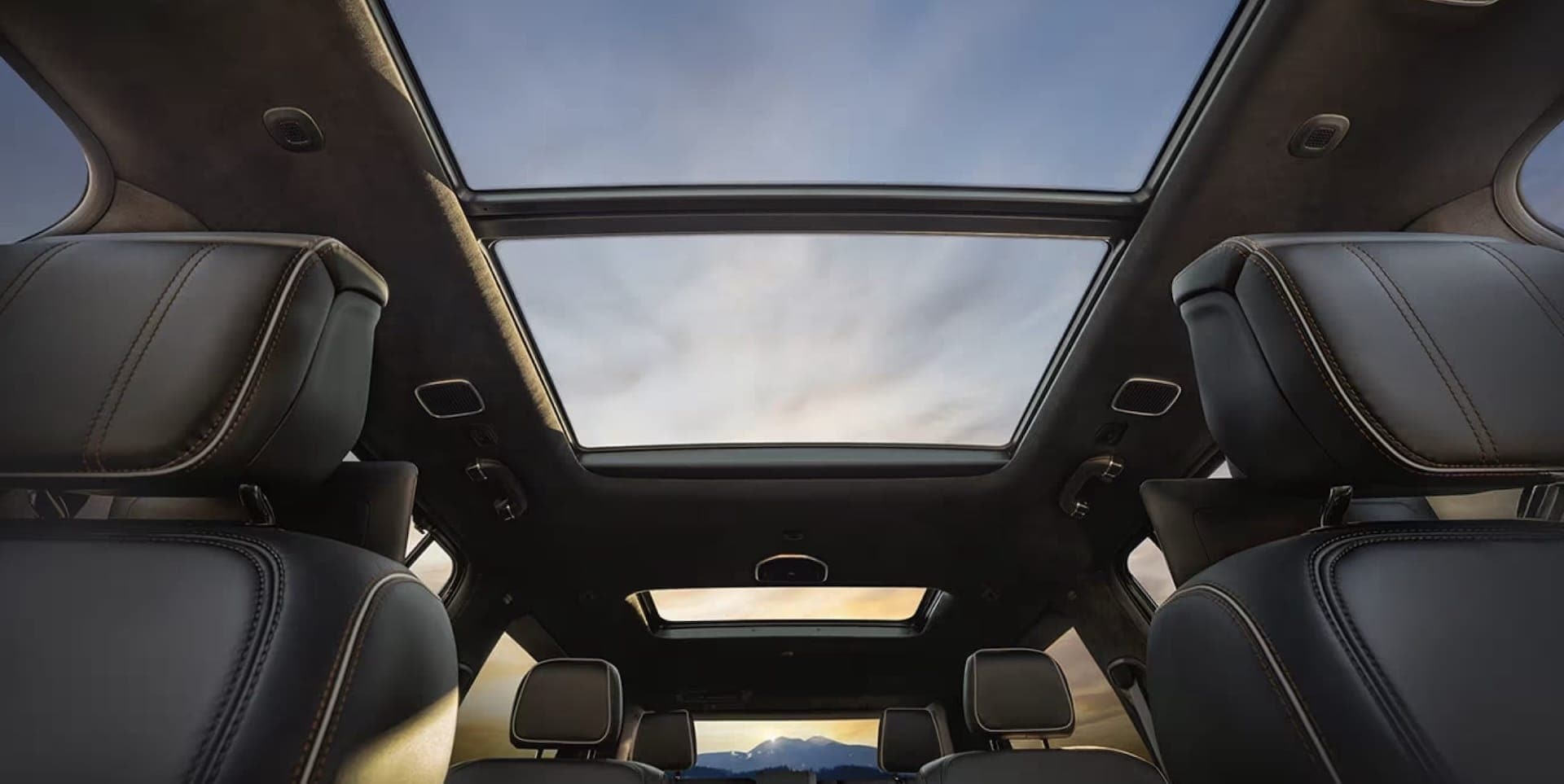
On materials, the Grand Wagoneer's case is the range of its seating surfaces: perforated Capri leather on the base car, Nappa on the Limited, premium Nappa on the Summit, and quilted Palermo leather with a suede headliner at the top of the lineup. Both vehicles are well finished; the Jeep offers more distinct grades of material as you climb.
Money
Pricing and Value
| Measure | Grand Wagoneer | Expedition |
|---|
| Base MSRP, excluding destination | $63,995 | $62,700 |
| Destination charge | $2,795 | $2,595 |
| Entry price with destination | $66,790 | $65,295 |
| Long-wheelbase premium | $3,000 | $3,000 |
| Basic warranty | 3 years / 36,000 miles | 3 years / 36,000 miles |
| Powertrain warranty | 5 years / 60,000 miles | 5 years / 60,000 miles |
Both figures are normalised to the same basis. Ford is $1,495 cheaper to get into once each brand's own destination charge is applied, and that is a real advantage worth naming plainly. Warranty is identical on both sides, so neither brand should claim it. Both apply the same $3,000 premium for the longer body.
Our Case
Where the Grand Wagoneer Wins
1. Cargo behind the third row, by a wide margin. 27.9 cubic feet against 21.6 on the standard wheelbase, and 42.6 against 36.1 on the long. That is 6.3 cubic feet on the body most people buy, measured the same way on both sides. For an NH family that fills every seat, it is the difference between the third row being usable with luggage and being usable instead of luggage.
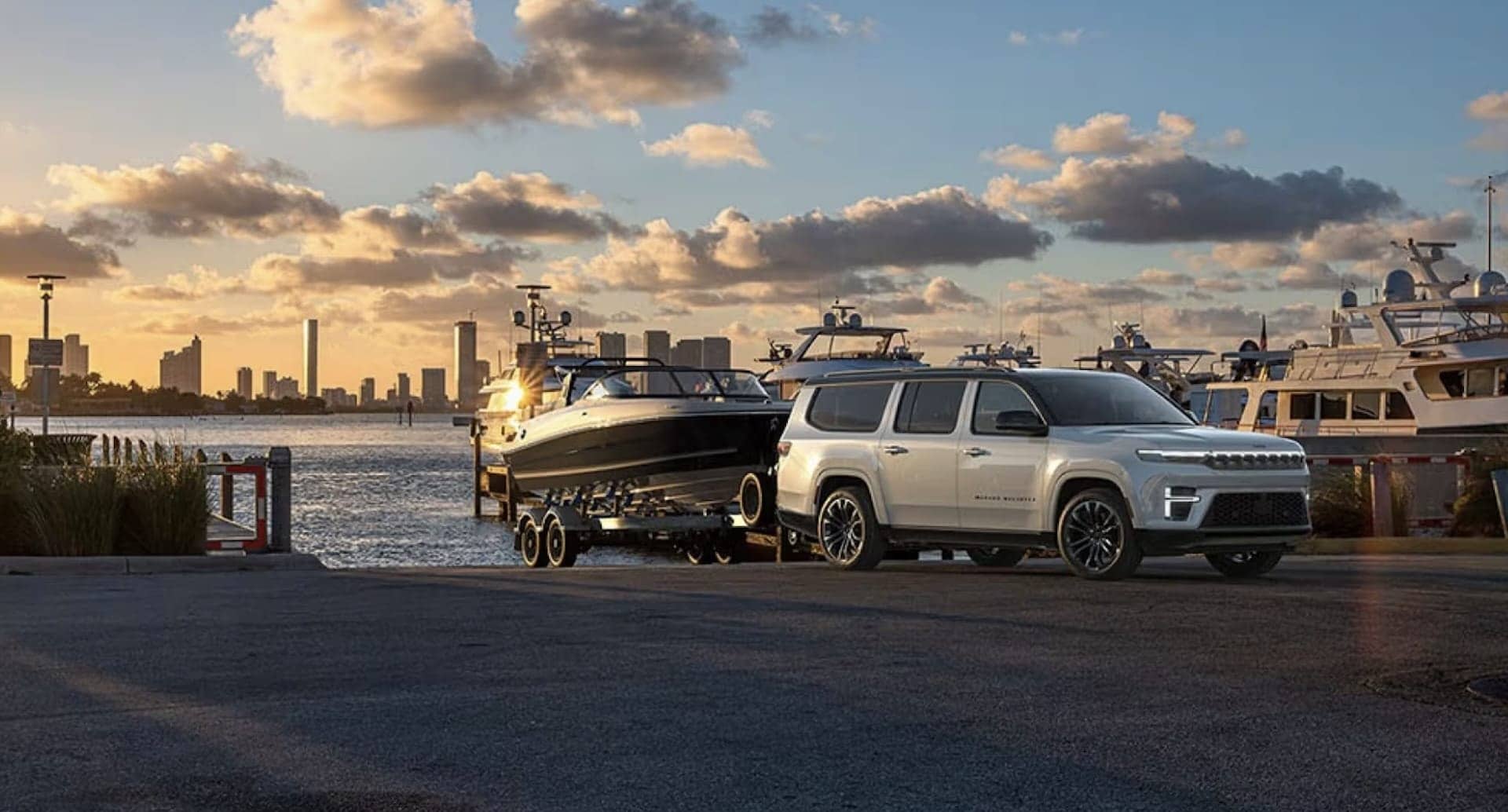
2. Maximum towing at matched configuration. 10,000 pounds against 9,600, both requiring four-wheel drive and the manufacturer's heavy-duty tow package. On the long wheelbase the gap grows to 860 pounds.
3. Fuel economy in every comparable drivetrain. 17/23/19 against 15/22/18 in four-wheel drive, and a city-mileage advantage in rear-wheel drive. On a full-size SUV in NH those are the figures you feel monthly. The Jeep also takes regular 87 octane, while Ford's High-Output engine requires 91 or higher.
4. A front passenger touchscreen the Expedition does not offer. The available 10.25-inch Front Passenger Interactive Display runs navigation, cameras, HDMI and the rear entertainment system. Ford does not list a front passenger display for the Expedition at any trim.
5. Second-row legroom. 42.7 inches against 41.1, which is where the people you actually carry most often sit.
Their Case
Where the Ford Expedition Wins
1. Hands-free highway driving, and this is the big one. BlueCruise lets you take your hands off the wheel on mapped highways. Jeep's Active Driving Assist is standard on every Grand Wagoneer but it is a hands-on-wheel, eyes-on-road system in Jeep's own description, and no Grand Wagoneer offers a hands-free equivalent at any price. On the King Ranch, Ford includes a one-year plus ninety-day plan. If this feature matters to you, it decides the comparison and the Expedition is the answer.
2. The more powerful engine option. The High-Output EcoBoost makes 440 horsepower and 510 lb-ft, standard on the Tremor and available on the Platinum, against the Grand Wagoneer's single 420-horsepower, 468 lb-ft engine. The Jeep has no upgrade engine to answer with.
3. A lower price of entry. $65,295 delivered against $66,790, a difference of $1,495 on like-for-like basis.
4. The 24-inch panoramic display. Ford's driver-facing screen is physically larger than anything Jeep fits in front of the driver, and the Ford Digital Experience with Google built in is a genuinely good system.
The Decision
Grand Wagoneer or Expedition: Which Should You Choose?
| If this describes you | Buy |
|---|
| You fill all three rows and still need luggage room | Grand Wagoneer. 27.9 cubic feet behind the third row against 21.6 is the single clearest gap between these two |
| You tow near the limit | Grand Wagoneer with the heavy-duty tow package and the 3.92 axle, rated 10,000 pounds against 9,600 |
| You drive long highway commutes and want the car to help | Expedition with BlueCruise. The Grand Wagoneer cannot match hands-free driving |
| You want the most power available | Expedition Tremor or Platinum with the High-Output engine at 440 horsepower |
| Fuel cost over a long ownership matters most | Grand Wagoneer, better in every comparable drivetrain and happy on regular fuel |
| You are buying at the entry price and nothing else decides it | Expedition by $1,495 delivered, though the Jeep's standard equipment closes much of that |
For the typical NH buyer cross-shopping these two, the Grand Wagoneer is our recommendation, and the space and towing figures are why. The Expedition earns its place on the shortlist for one specific reason, and if hands-free driving is on your list it should win. See our Grand Wagoneer inventory and drive one before you decide.
Local
Test Drive the Grand Wagoneer at Jeep Portsmouth
We are at 2355 Lafayette Rd, Portsmouth, NH 03801, and you can reach us at (603) 431-8900. We sell the Jeep and not the Ford, which is exactly why the Expedition's advantages are stated plainly above rather than buried.
The comparison that matters on the NH coast is not the spec sheet but the winter. Where roads carry salt for months and side streets go unplowed for hours after a storm, a full-time four-wheel-drive system that decides for itself how to split torque does real work, and both of these vehicles offer capable systems. Bring your own trailer or your own car seats to our NH lot and try the one you are actually considering. Buyers reach us easily from Hampton and Seabrook to the south and the Route 101 corridor inland.
Questions
Grand Wagoneer vs Expedition FAQs
Which tows more, the Grand Wagoneer or the Expedition?
The Grand Wagoneer, by 400 pounds. It is rated 10,000 pounds with four-wheel drive and the 3.92 axle from its heavy-duty tow package; the Expedition is rated 9,600 pounds with four-wheel drive, the 3.73 axle and Ford's Heavy-Duty Trailer Tow Package. On the long wheelbase the gap widens to 860 pounds, 9,860 against 9,000.
Which has more cargo space behind the third row?
The Grand Wagoneer, with 27.9 cubic feet against the Expedition's 21.6 on the standard wheelbase, and 42.6 against 36.1 on the long wheelbase. Note that Ford also publishes a larger figure of 22.9 cubic feet measured with the third row slid full upright, which is not the same measurement as Jeep's, so compare the standard figures.
Does the Grand Wagoneer have hands-free driving like BlueCruise?
No. Active Driving Assist is standard on every Grand Wagoneer, but Jeep describes it as a hands-on-wheel, eyes-on-road system. Lane centring plus speed and brake management, all of it with hands remaining on the wheel. Ford's BlueCruise is genuinely hands-free on mapped highways. If that feature is a requirement, the Expedition meets it and the Grand Wagoneer does not.
Does the Expedition have more third-row legroom?
They are effectively identical: 36.6 inches in the Grand Wagoneer and 36.5 in the Expedition. A tenth of an inch is inside the range where neither should claim an advantage. Second-row legroom is a clearer difference, 42.7 inches against 41.1 in the Jeep's favour.
Which is more powerful?
It depends which Expedition. The Grand Wagoneer's single engine makes 420 horsepower and 468 lb-ft, which beats the Expedition's standard 400 horsepower but gives up 12 lb-ft of torque. Ford's optional High-Output engine, at 440 horsepower and 510 lb-ft, beats the Jeep on both counts, and the Grand Wagoneer has no upgrade engine to answer it. Note that Ford rates its outputs on premium fuel.
Which is cheaper?
The Expedition, by $1,495 at the entry point. It opens at $62,700 plus a $2,595 destination charge for $65,295 delivered; the Grand Wagoneer opens at $63,995 plus $2,795 for $66,790. Both apply a $3,000 premium for the long-wheelbase body, and warranty terms are identical at 3 years or 36,000 miles basic and 5 years or 60,000 miles powertrain.
Which gets better gas mileage?
The Grand Wagoneer, in every comparable drivetrain. In four-wheel drive it is EPA-rated 17 city, 23 highway and 19 combined against the Expedition's 15/22/18. In rear-wheel drive it is 17/24/19 against 16/24/19. The Jeep also accepts regular 87 octane throughout, while Ford's High-Output engine requires 91 or higher.
Does the Expedition have a front passenger screen?
Ford does not list a front passenger display for the 2026 Expedition at any trim. Its screen headline is a 24-inch panoramic driver display paired with a 13.2-inch centre touchscreen. The Grand Wagoneer offers an available 10.25-inch Front Passenger Interactive Display that runs navigation, media, vehicle cameras, HDMI input and the rear-seat entertainment system.
Drive the Grand Wagoneer Before You Decide
Both are strong vehicles and the spec sheets are close in places, and NH winters test them both. Twenty minutes behind the wheel settles more than any table can.
Keep Researching