Capability
2026 Jeep Grand Wagoneer Towing Capacity NH
Up to 10,000 pounds, properly equipped on a conventional hitch. The configuration that earns it, and the one that does not.
10,000 lbs max, 4x4 with 3.92 axleAbout 1,560 lb payload, 4x416,500 lb GCWR with Max Tow468 lb-ft of torque
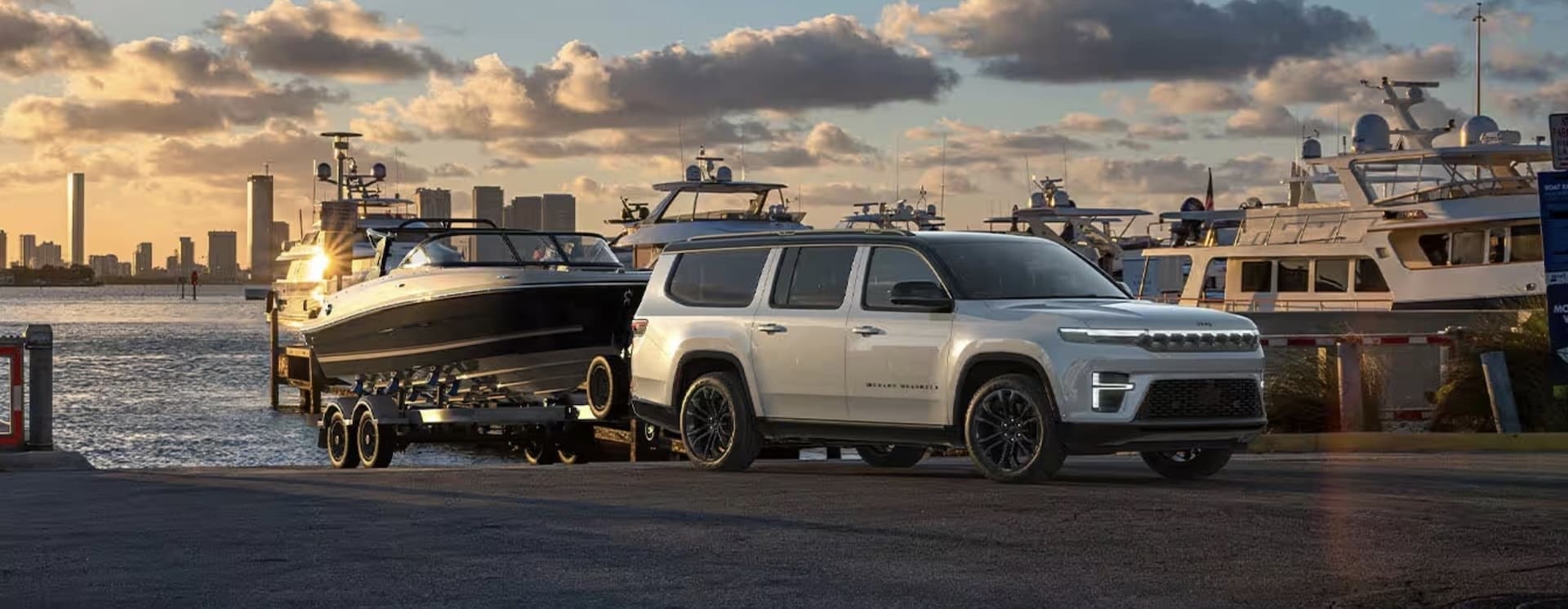
The 2026 Jeep Grand Wagoneer is rated to tow up to 10,000 pounds properly equipped on a conventional hitch, and that rating belongs to exactly one build: the short-wheelbase body, four-wheel drive, and the 3.92 axle ratio, which arrives either with the heavy-duty trailer tow package or bundled into the Upland. Order the same four-wheel-drive vehicle on the standard 3.55 axle and the rating is 6,030 pounds. That is not a rounding difference, it is the whole boat.
If you are shopping this SUV in NH because of the tow number, the axle ratio is the single option that decides whether you get it. This page lays out every published rating by configuration, what the tow package actually contains, the weight limits that matter once a trailer is attached, and what those figures mean for the boats and campers people around here actually pull. We will read the axle ratio off a specific unit before you drive over: call (603) 431-8900.
The Ratings
Maximum Towing Capacity by Configuration
| Body | Drivetrain | Axle ratio | Max trailer weight |
|---|
| Grand Wagoneer | Rear-wheel drive | 3.55 | 6,210 lbs |
| Grand Wagoneer | Four-wheel drive | 3.55 | 6,030 lbs |
| Grand Wagoneer | Four-wheel drive | 3.92 | 10,000 lbs |
| Grand Wagoneer L | Rear-wheel drive | 3.55 | 5,960 lbs |
| Grand Wagoneer L | Four-wheel drive | 3.55 | 5,770 lbs |
| Grand Wagoneer L | Four-wheel drive | 3.92 | 9,860 lbs |
Every figure is properly equipped on a conventional hitch. Three things in that table are worth reading twice.
The 3.92 axle is the whole story. Between the second and third rows, nothing changes except the final drive ratio, and the rating goes from 6,030 to 10,000 pounds. Nothing about the badge on the tailgate or the price of the configuration tells you which axle is underneath.
On the 3.55 axle, rear-wheel drive out-tows four-wheel drive. 6,210 against 6,030, because the four-wheel-drive hardware adds weight that comes off the trailer rating. It is counterintuitive and it is what Jeep publishes.
The long wheelbase tows slightly less. The Grand Wagoneer L tops out at 9,860 pounds against the short wheelbase's 10,000. If you want both maximum towing and maximum cargo, those two goals pull against each other by 140 pounds of rating.
Weight Limits
Maximum Payload by Configuration
Payload runs from about 1,420 to 1,570 pounds depending on configuration. The short-wheelbase four-wheel-drive Grand Wagoneer carries roughly 1,560 pounds; the rear-wheel-drive version about 1,570; the long-wheelbase L about 1,420 to 1,515. Jeep's own spec sheet prints one flat payload figure for every configuration, but that figure contradicts the gross weight ratings on the same sheet and the per-trim figures on jeep.com, so we publish the configuration-specific numbers and recommend confirming on the door-jamb sticker. It varies by body and drivetrain, so the figure that matters is the one for the configuration you are buying, not a lineup, and any source showing it changing per trim is describing a different vehicle or a different model year.
Payload is the limit most towing buyers overlook, because trailer tongue weight counts against it alongside people and luggage. Load seven adults into a Grand Wagoneer and you have used a good share of roughly 1,560 pounds before the trailer is hitched. The published tongue weights and combined ratings, all on the 3.92 axle:
| Configuration | GCWR | Max tongue weight |
|---|
| Grand Wagoneer, four-wheel drive | 15,000 lbs | 820 lbs |
| Grand Wagoneer, four-wheel drive, Max Tow | 16,500 lbs | 981 lbs |
| Grand Wagoneer L, four-wheel drive | 15,000 lbs | 793 lbs |
| Grand Wagoneer L, four-wheel drive, Max Tow | 16,500 lbs | 945 lbs |
Gross vehicle weight rating runs from 7,300 pounds on the rear-drive short wheelbase to 7,950 pounds on the four-wheel-drive Summit L. Curb weights run from 5,730 to 6,444 pounds; the full table is on the specs page. For a 3.55-axle build, tongue weight and combined rating are on the vehicle's own door placard and hitch label, and we will read them off the unit for you rather than quoting a figure that may not apply to it.
The Hardware
Trailering Packages and Features
Jeep offers one tow package on this vehicle, the Heavy-duty Trailer Tow package, available on four-wheel-drive builds only and optional on every configuration. It is what turns a 6,030-pound Grand Wagoneer into a 10,000-pound one, and it carries considerably more than a hitch.
| Included in the Heavy-duty Trailer Tow package | Why it matters |
|---|
| 3.92 final drive ratio | The single component that raises the rating to 10,000 pounds |
| Two-speed transfer case | Adds a 2.64 low range, useful pulling a boat up a wet ramp |
| Electronic limited-slip differential | Manages traction across the rear axle under load |
| Integrated trailer brake control | Required equipment above 2,000 pounds of trailer |
| Trailer light monitoring and trailer tire pressure monitoring | Tells you about a failure before someone flashes their headlights at you |
| Blind-spot Monitoring with Trailer Tow Detection | Extends the blind-spot zone to cover the trailer's length |
| Trailer hitch zoom | Magnifies the camera view at the hitch for solo hookups |
| Selec-Speed Control | Holds a set speed on a descent without riding the brakes |
| Removable front and rear tow hooks | Recovery points |
| Adjustable roof rail crossbars | Bundled in the same package |
The Upland configuration bundles this same hardware as part of its package, along with Quadra-Lift air suspension, skid plates and all-terrain tires, which makes it the most equipped route to a maximum-tow Grand Wagoneer. It is not the cheapest one: the same 10,000-pound rating arrives on a base Grand Wagoneer 4x4 at $66,995 with the $1,995 Heavy-duty Trailer Tow package, or $68,990, and the Upland's extra $4,070 buys the air suspension, skid plates and all-terrain tires rather than any additional towing capability. See the trims page for how it compares against the similarly priced Limited Altitude, which does not carry any of this.
Two practical requirements from Jeep's own guidance. Trailer brakes are recommended above 1,000 pounds and required above 2,000 pounds. And once gross trailer weight reaches 5,000 pounds, Jeep recommends a weight-distributing hitch for stable handling. Both thresholds sit well below the headline rating, so most people towing anything substantial will need both.
Technology
Available Trailering Technology
The camera and monitoring systems are where towing a large SUV has genuinely changed. Trailer hitch zoom magnifies the view at the ball so you can back onto a coupler alone, without someone standing behind the vehicle waving. The 360-degree surround view camera, available across the lineup and standard on Summit, gives an overhead composite that makes lining up in a crowded ramp lot considerably easier.
Trailer light monitoring and trailer tire pressure monitoring both report to the 12-inch Uconnect screen, so a blown trailer bulb or a soft trailer tire surfaces on the dash rather than fifty miles later. Blind-spot Monitoring with Trailer Tow Detection extends the monitored zone rearward to account for what you are pulling, which matters merging onto a highway with a boat behind you.
The vehicle also carries the drive modes that suit a loaded trailer: the standard full-time four-wheel-drive system includes a dedicated Tow mode alongside Auto, Snow, Mud, Sand and Sport. On builds with the two-speed transfer case, the 2.64 low range is what you want on a steep, wet launch.
Translation
What Can the 2026 Grand Wagoneer Actually Tow?
Trailer weights vary far too much by model, options and how you load them for a published range to be worth much. What is worth knowing is the gap between the two ratings you can actually order, because that gap decides which category of trailer is open to you. On the 3.92 axle the short-wheelbase Grand Wagoneer is rated 10,000 pounds; on the standard 3.55 axle the same four-wheel-drive vehicle is rated 6,030. That is a difference of 3,970 pounds, and it is the difference between most categories below being available or not.
| What you are pulling | 3.55 axle, rated 6,030 lbs | 3.92 axle, rated 10,000 lbs |
|---|
| Pair of personal watercraft on a double trailer | Well within rating | Well within rating |
| Small utility or landscape trailer | Well within rating | Well within rating |
| Teardrop or small travel trailer | Within rating, weigh it loaded | Well within rating |
| Mid-size bowrider or centre console on a trailer | Marginal, many are over | Within rating |
| Two-horse trailer, loaded | Generally over the limit | Within rating |
| Larger travel trailer | Over the limit | Within rating on most, weigh it first |
Weigh your own rig loaded rather than trusting a brochure dry weight. A trailer's dry figure excludes water, fuel, gear and anything stored inside, and on a camper that gap runs into four figures. Bring the actual number to us and we will match it to a build.
The build to shop if towing is the reason. A four-wheel-drive Grand Wagoneer on the short wheelbase with the Heavy-duty Trailer Tow package and the 3.92 axle, or an Upland, which bundles the same hardware. Anything at or above roughly 5,000 pounds also wants a weight-distributing hitch, and anything above 2,000 pounds requires trailer brakes.
The build to avoid if towing is the reason. Any 3.55-axle configuration, regardless of price. A $94,310 Summit Obsidian on the standard axle tows less than a $63,995 base car with the tow package, and there is nothing on the outside of either vehicle that tells you which is which. Check our stock and we will confirm the axle before you come in.
Local
Real-World Towing on the NH Seacoast
Most towing that starts at our NH door ends at a boat ramp. The Great Bay Marine launch in Newington and the Hilton Park ramp at Dover Point are the two that see the most Grand Wagoneer traffic from this store, and both share the feature that makes low range worth having on the NH coast: a wet, sloped concrete apron where a loaded trailer wants to pull you backward. The 2.64 low range in the two-speed transfer case is the difference between easing a boat out and slipping.
The other NH pattern is the longer haul. A camper leaving the NH Seacoast for the lakes region runs Route 16 north, which is a sustained grade with traffic, and this is where the 468 lb-ft torque peak at 3,500 rpm does its work: the eight-speed holds a gear instead of hunting. Coming back down the same road loaded is where Selec-Speed Control keeps you off the brakes.
One NH constraint worth naming: the winter salt that gets on everything here gets on trailer wiring and hitch hardware too. Rinse the connector and the receiver after a cold-season launch, and check the trailer light monitoring readout before you rely on it in the spring.
Questions
Towing FAQs
How much can a 2026 Jeep Grand Wagoneer tow?
Up to 10,000 pounds properly equipped on a conventional hitch, which requires the short-wheelbase body, four-wheel drive and the 3.92 axle ratio from the Heavy-duty Trailer Tow package. On the standard 3.55 axle the four-wheel-drive model is rated 6,030 pounds and the rear-drive model 6,210. The Grand Wagoneer L tops out at 9,860 pounds.
What do I need to get the full 10,000-pound rating?
Three things together: the short-wheelbase Grand Wagoneer body, four-wheel drive, and the 3.92 axle ratio. The axle only comes with the Heavy-duty Trailer Tow package, which is four-wheel-drive only. The Upland configuration bundles that hardware as standard equipment, so it tows the maximum as it sits, though at $73,060 it is not the cheapest route to that rating.
Why does the rear-wheel-drive model tow more than four-wheel drive?
On the standard 3.55 axle, rear-wheel drive is rated 6,210 pounds and four-wheel drive 6,030. The four-wheel-drive hardware adds vehicle weight, and that weight comes out of the trailer rating. It reverses entirely once the 3.92 axle is fitted, since that package is four-wheel-drive only and takes the rating to 10,000 pounds.
What is the payload and tongue weight of a Grand Wagoneer?
Payload varies by configuration, roughly 1,420 to 1,570 pounds, with the four-wheel-drive short wheelbase near 1,560. Maximum tongue weight on the 3.92 axle is 820 pounds on the short wheelbase and 793 on the Grand Wagoneer L, rising to 981 and 945 pounds respectively in the Max Tow configuration. Tongue weight counts against payload, so a full vehicle plus a heavy tongue reaches the limit quickly.
Do I need a weight-distributing hitch or trailer brakes?
Jeep recommends a weight-distributing hitch once gross trailer weight reaches 5,000 pounds. Trailer brakes are recommended above 1,000 pounds and required above 2,000 pounds. Both thresholds are well below the maximum rating, so anything substantial needs both. Integrated trailer brake control is part of the Heavy-duty Trailer Tow package.
Can a Grand Wagoneer tow a travel trailer or a boat?
Yes, within the rating for its axle. A properly equipped 3.92-axle build at 10,000 pounds handles a mid-size boat, a two-horse trailer or a larger travel trailer. A 3.55-axle build at 6,030 pounds covers watercraft, utility trailers and small campers but sits at or over the limit for a mid-size boat. Weigh your loaded rig rather than trusting a dry weight from a brochure.
We Will Check the Axle Before You Drive Over
The difference between a 6,030-pound Grand Wagoneer and a 10,000-pound one is invisible from the outside. Tell us what you tow and we will find the right build anywhere in NH.
Keep Researching